
Developing London Chinatown as an Iconic Destination
Sometimes the most effective marketing innovations emerge in unexpected ways. In destination marketing, creative responses often follow a familiar pattern: a client requests an advertising solution, and an advertising campaign is delivered. But every so often, a brief invites a different way of thinkingWhen we think about shopping malls, we think about convenience, leisure, and community. But behind the scenes, these bustling public spaces are increasingly vulnerable to a wide range of emergencies from medical incidents and technical malfunctions to severe threats like fire, active shooters, or cyberattacks.
That was the case when we were approached by the owners of London Chinatown. What began as a seemingly straightforward assignment became one of my favourite projects, not only because of its simplicity, but because of its lasting impact on the city.
The Challenge
Despite its prime central London location, Chinatown presented a surprising challenge: for visitors unfamiliar with the capital, it was difficult to find. The brief was clear: find a way to put Chinatown more firmly on the map.
Innovation
The initial assumption was that the solution would be an advertising or PR campaign. Instead, we reframed the challenge. This wasn’t an awareness problem; it was a wayfinding problem.
Visibility from surrounding streets was critical, but traditional signage is notoriously difficult to introduce in dense, historic urban environments. Rather than competing with visual clutter, we proposed an alternative: a bold, physical icon that would act as an unmistakable announcement of place.
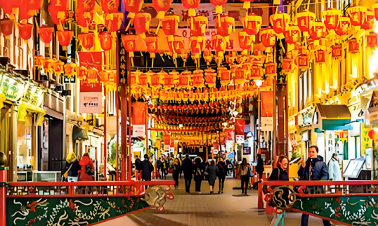
We identified the traditional Chinese lantern as the perfect visual cue—culturally authentic, instantly recognisable, and emotionally resonant. Rather than directing people to Chinatown, the lanterns would reveal it.
Think Bigger
Initially, the client envisaged installing a single large lantern at each entrance. We encouraged them to think more ambitiously. The result was a decision to install not one or two lanterns, but thousands.
The transformation was immediate. Chinatown became visible from every approach, glowing above the streets and drawing people in instinctively. What had once been easy to miss became impossible to ignore—and uplifting to encounter.
"The best ideas often feel inevitable in hindsight - so seamlessly integrated that they become part of the story rather than the marketing."
Impact
The project stands as a powerful example of placemaking in action. It solved a practical wayfinding issue while simultaneously adding a rich experiential layer to the district. The lanterns became a defining feature of Chinatown and, inevitably, a must-see Instagram moment for visitors.
Today, it’s hard to imagine Chinatown without them. For us, the ultimate measure of success is that the idea feels so obvious it's surprising no one introduced it sooner. It has become a part of the destination’s story rather than a visible piece of “marketing.”
Alan Thornton
Connect with meMore About the Author
Alan Thornton is Managing Director of UK-based AL Marketing. With a wealth of experience across retail and luxury destinations, Alan led marketing at Topshop during its peak years and has shaped brands such as Covent Garden, Carnaby, and Whiteleys. He is also the Joint Managing Director of the global Solal Marketing Awards.