
Last month an investor called me. He had a 20-year-old regional shopping centre under offer and wanted a second opinion. I have had a version of this conversation many times this year, so I'm sharing it, lightly edited.
Investor: Everyone tells me retail is back. Is it?
Me: Partly. Vacancy in European shopping centres is back to around 6%. Over the last three years, investor sentiment has improved more for retail than for any other core sector.
Investor: So it's a good time to buy.
Me: It can be. But ask where your return will come from. AEW expects European shopping centres to return about 8.6% a year to 2030, and almost all of that is income. Yields may tighten by only about 30 basis points. Rents may grow about 1.2% a year.
Investor: And outside Europe?
Me: A similar picture, with local differences. Dubai is the exception for now: Dubai Mall is about 98% let and city-wide retail rents rose about 7.7% last year. In Riyadh, large malls are 91% occupied, but rents rose only 1.2% in a year. In Singapore, vacancy is about 6% and Savills expects mall rents to grow 1–2% this year. The best centres are full almost everywhere. Rents are rising slowly. The market won't lift your price for you.
Investor: Then what makes the difference?
Me: The customer and the experience you give them. Footfall and tenant sales follow the customer, and the customer follows the experience. The centres that lose usually have good bricks and a blurred identity.
Investor: Have you seen that happen?
Me: Many times. Same city, same shoppers. Similar tenant mix but very different experiences
Investor: Does experience really pay when times are hard?
Me: I opened Aviapark in Moscow in November 2014, in the middle of an economic crisis. It is about 230,000 m², built over a metro line, with family and leisure anchors such as a large aquarium. People said it was the worst possible moment. It became Russia's leading destination for more than a decade. Before that I ran Mega Teply Stan up to a peak of 37 million visitors a year. People don't travel to a mall 37 million times for a shopping list. They come for the place.
Investor: But AI is coming. Won't people just let an assistant do their shopping?
Me: For a lot of shopping, yes. AI assistants and agents are already starting to filter what people see and steer what they buy. The shift will hit some markets first, where people already live on super-apps and digital payments, such as China and Korea. Others will follow faster than most owners expect. The trip to buy a shopping list will shrink.
“AI will change how people shop. It won't change why people want to be together. The centres that understand this will be the winners of the next 20 years.”
Investor: That sounds like bad news for malls.
Me: Only for malls that are just shops. Life will adapt, and the experience will matter more. AI can find you a product. It can't eat with your friends, take your children to a workshop, or give you the feeling of a busy square on a Saturday. Human contact is one of the things AI cannot replace. Our centres should become the places where people meet those human needs.
Investor: So no technology?
Me: The opposite. The best centres will be phygital: physical and digital working together. Use AI to read footfall and sales, personalise offers and plan events. Make sure your centre and its tenants are visible and accurate in the AI tools people will use to decide where to go. Then make the visit itself something no screen can give.
Investor: So what would you look at first, before I buy?
Me: Seven pillars.
Clear identity. Can a customer describe the centre in one sentence? Miyashita Park in Tokyo merged shops, restaurants, a hotel and a public park on the roof into one lifestyle place. It is impossible to copy.
Customer and community. Who shops here today, and who will in ten years? Has the catchment changed: new housing, an older population, new competitors? If the customer has changed, the centre must adapt. At Aviapark, the family and leisure focus came from knowing the catchment area development.
Experience beyond retail. Food, leisure, culture and events that give reasons to come and stay. Starfield COEX in Seoul put an open library with towering bookshelves in the middle of the mall. It became a free cultural venue, a meeting point and a photo spot.
Local culture and storytelling. ICONSIAM in Bangkok has an indoor floating market showing food and crafts from Thailand's regions, and you can arrive by boat. Local culture, presented with quality, creates real pride of place.
Integration and landmark. Jewel Changi in Singapore built shops and dining around a giant indoor waterfall, linked straight to the airport. It serves residents, travellers and tourists at once.
Innovation and execution. The rent roll, the leasing pipeline, operations, costs and the team. SKP Chengdu keeps renewing its concepts and installations so customers keep coming back.
Future-readiness. Is the centre ready for the next 20 years?
Investor: How do you judge the next 20 years?
Me: With the megatrends. The Copenhagen Institute for Futures Studies published its Megatrends report in September. Some of them land directly on a mall:
Ageing. In many catchments, demand moves to accessibility, comfort, health and daytime programmes. In young markets, it's entertainment, education and family leisure. Two different playbooks.
People living alone. Households are getting smaller and loneliness is rising. A centre can be a 'third place' for meeting, classes and clubs, not just for buying.
Health beyond the clinic. The wellness economy has roughly doubled since 2013. Clinics, diagnostics and fitness are a strong new use for empty department store boxes.
Growth and decline side by side. Around 3,000 cities lost population between 2015 and 2025. Be honest about which kind of town your centre serves.
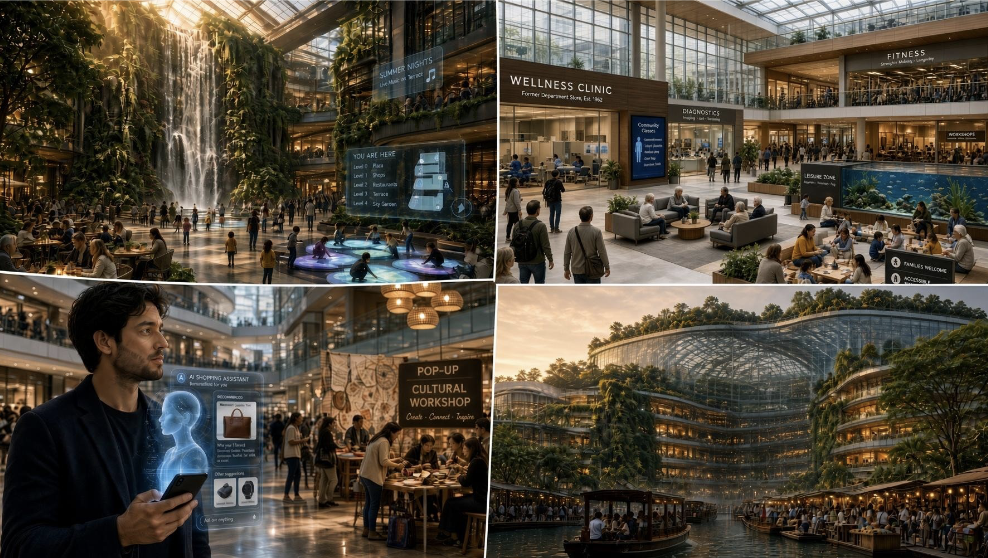
Investor: My centre is in a smaller city.
Me: Then we check that first. A shrinking catchment doesn't kill a centre, but it changes the right mix and the right size. Sometimes the answer is less retail and more services, health or homes on part of the site. In a fast-growing city it's the other way round. At Tashkent City Mall our job was to set a new standard for shopping and leisure in a market that was growing fast.
Investor: The seller has a refurbishment plan with beautiful renderings.
Me: I love renderings. But a plan that starts with the architect is in the wrong order. First the customer, then the identity and the experience, then the tenant mix, and only then the building. Otherwise you get a beautiful mall with no reason to visit.
Investor: So, should I buy it?
Me: Maybe. But not before you know it properly, pillar by pillar, and know what its catchment will look like in ten years. That tells you whether you're buying an income stream or a problem.
Investor: And if the answer is yes?
Me: Then buy it. And don't run it only like a property, or only like a business. Run it as an experience. The numbers follow.
AI will change how people shop. It won't change why people want to be together. The centres that understand this will be the winners of the next 20 years.
Over to you: what would you ask next if you were the investor on that call?
More About the Author