
Ghalia Boustani on ‘Why Flexible Retail Spaces Are Shaping the Next Era of Physical Retail’
The retail sector is undergoing structural transformation driven by technological innovation, evolving consumer behaviour, and socio-economic change. Traditional brick-and-mortar formats, such as department stores and enclosed shopping centres, are increasingly challenged by e-commerce penetration, omnichannel retail strategies, shifting mobility patterns, and consumer preferences for experiences over transactions. In this context, flexibility emerges as a critical determinant of competitiveness and long-term viability. Flexible retail environments can be conceptualised as adaptive systems capable of reconfiguring spatial, functional, and technological components in response to fluctuating market conditions and cultural contexts. This article examines the strategic and operational mechanisms underpinning such flexibility, drawing on professional literature as well as empirical case studies from Paris, France.
1. From Fixed Formats to Fluid Configurations
Historically, retail environments were conceived as fixed spatial formats designed for long-term stability. This rigidity was functional in periods of relatively stable demand and slow-moving consumer trends. However, contemporary retail is marked by volatility, uncertainty, complexity, and ambiguity (VUCA), necessitating agile and modular design principles.
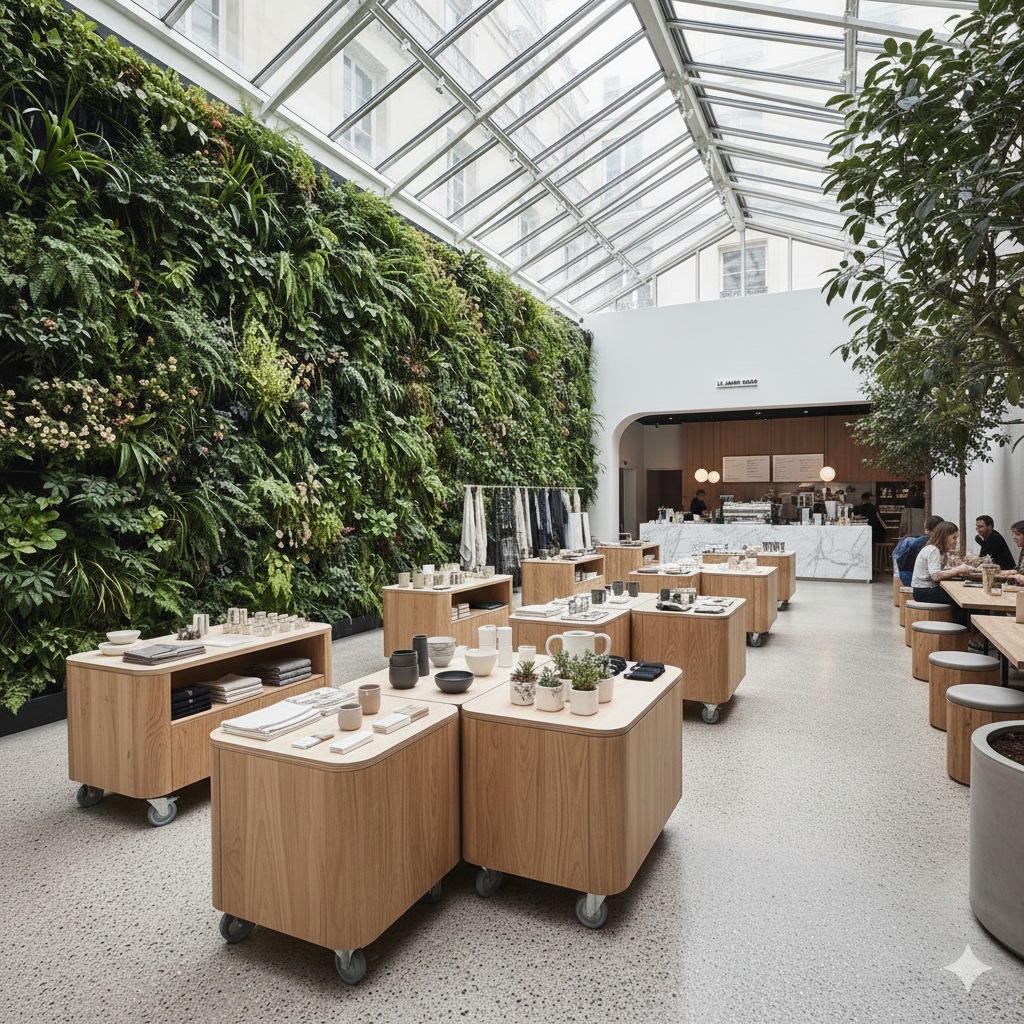
While department stores have redefined themselves as hybrid cultural-commercial destinations, shopping malls—once symbolic of suburban leisure consumption—are increasingly repositioned as multi-use urban hubs. This shift from format to fluidity is underpinned by three drivers: (1) the integration of diverse uses (retail, entertainment, community functions), (2) the embedding of digital and data-driven systems, and (3) the capacity for rapid spatial and programmatic reconfiguration.
Uncertainty
From supply chain shifts to inflation and unpredictable consumer behaviour, the landscape changes constantly. Leaders are pushing forward with optimism, but with grounded realism.
2. Hybridisation as an Operational Strategy
Hybridisation is a prominent manifestation of retail flexibility, defined as the deliberate integration of multiple consumption and experiential modes within a single spatial framework.
Co-locating leisure, cultural, and retail functions can significantly extend dwell time, increasing both the duration and value of customer visits. Pop-ups, immersive installations, and curated events add novelty and help differentiate a brand, strengthening its equity. Digital layers—such as augmented reality and app-based wayfinding—further enrich the customer journey and boost engagement. However, these strategies also introduce challenges. Coordinating diverse functions adds operational complexity and raises logistical demands. The required investment in modular infrastructure and technology can be capital intensive, particularly for smaller operators. Additionally, if experiences are poorly curated, they may dilute the brand and weaken overall coherence.
"Retail spaces must evolve from static properties into adaptive ecosystems."
3. Paris as an Empirical Context
Paris offers a diverse urban laboratory for examining flexible retail models:
- Châtelet–Les Halles (Westfield Forum des Halles): Capitalises on extreme footfall from Europe’s busiest transport interchange by integrating gastronomy, cultural partnerships, and performance programming to convert transient flows into sustained engagement.
- Les Quatre Temps / La Défense: Balances weekday functional retail for office workers with weekend leisure programming for families, demonstrating temporal flexibility in audience targeting
- Beaugrenelle: Employs a design-led, upscale positioning with fashion, dining, and cultural installations—exemplifying the “department store-inspired” mall.
- La Vache Noire: A suburban model where flexibility is rooted in community integration—events, local services, and family-oriented activities maintain relevance in daily life.
These cases demonstrate that flexibility is not solely an architectural property but a multidimensional strategy combining audience analysis, locational context, and adaptive programming.
4. Lessons from Parisian Department Stores
The adaptability of Galeries Lafayette, Printemps, and Le Bon Marché illustrates that heritage retail formats can adopt phygital integration (click-and-collect lounges, mobile-assisted selling) and experiential layering (fashion shows, exhibitions).
Service-oriented features can strengthen customer loyalty and increase average spending, while cultural programming helps position the brand as a civic and social institution. However, these initiatives require ongoing investment in events and programming, which may not generate immediate returns. There is also the risk of alienating core clientele if such changes are seen as diluting the brand’s traditional identity.
5. Determinants of Performance Divergence
Empirical evidence indicates that the performance of retail spaces is influenced by a combination of strategic, spatial, cultural, and operational factors. Strategic management plays a decisive role, with the active curation of tenant mixes and innovative marketing initiatives shaping both footfall and brand perception. Accessibility is equally critical: locations that are well connected to public transportation and embedded within vibrant urban amenities tend to perform better. The cultural alignment of the retail offer with the values, tastes, and aesthetics of the surrounding community further strengthens relevance and resonance. Operational flexibility also matters, as successful spaces are those that can swiftly adapt to seasonal shifts or emerging consumer trends. Finally, collaboration among retailers—through shared activations and integrated technologies—can generate synergies that enhance visibility, customer experience, and overall commercial outcomes.
6. Framework for Technical and Strategic Flexibility
Flexible retail strategies can take many forms. Modular and reconfigurable layouts facilitate rapid adaptation to shifting retail formats and evolving consumer demands, although they may sometimes result in underutilization of fixed infrastructure and higher maintenance costs. Short-term and flexible leasing models support experimentation by emerging brands and enable agile retail responses, but they can make revenue streams volatile for landlords due to frequent tenant turnover. Multi-purpose shared spaces foster community engagement through diverse programming, such as markets, workshops, and performances, though they require sustained curatorial effort to keep offerings relevant and fresh. Technology integration enhances personalization, operational efficiency, and data-driven adaptability, yet it introduces complexities related to data privacy, infrastructure maintenance, and coordination across systems. Sustainable and cost-efficient design aligns retail offerings with environmental and ESG expectations through reusability and reduced waste, even if it often requires higher upfront investment in materials or systems. Finally, blending physical and digital experiences through phygital integration harmonizes online and offline touchpoints to create seamless omnichannel journeys, but presents challenges in unifying data flows and maintaining coherence between the digital and physical realms.
Conclusion
Flexible retail spaces represent an adaptive response to the structural challenges facing physical retail. The Parisian context illustrates that such flexibility can manifest in diverse forms—from high-traffic transit hubs employing cultural anchors to suburban centres embedding themselves in local routines. While the benefits of adaptability are significant, they must be weighed against operational complexity, investment requirements, and potential brand dilution. Strategic success lies in aligning spatial adaptability with deep consumer insight and coherent brand positioning.
We have the expertise to help you tackle your retail space’s big questions. From concept to execution, we collect and analyse relevant data, provide insightful reports, and support strategic decisions that make your retail environments agile, engaging, and future-ready. Whether it’s optimising layouts, integrating digital tools, or designing immersive experiences, we help transform your spaces into adaptable, high-performing destinations.
Ghalia Boustani
Connect with meMore About the Author
Ghalia Boustani is an Ephemeral Retailing Specialist, published author, and podcast host with a strong focus on flexible retail models, experiential spaces, and urban commercial strategy. Her work bridges research and practice, helping brands, landlords, and destinations rethink how physical retail can adapt to changing consumer behaviours and market dynamics. Through writing, consulting, and conversations with industry leaders, she explores how temporary, hybrid, and adaptive retail formats create long-term value in a rapidly evolving landscape.