What the Royal Pop Phenomenon Teaches Retail About Future-Ready Leadership
What the Royal Pop Phenomenon Teaches Retail About Future-Ready Leadership
What the Royal Pop Phenomenon Teaches Retail About Future-Ready Leadership
Retail has always rewarded those who surprise the market. Yet many leadership teams still rely on the opposite approach: analysing yesterday’s data, monitoring competitors, and responding to trends once they become visible.
That is responsive leadership.
The spectacular success of the Swatch × Audemars Piguet Royal Pop collaboration demonstrates why anticipatory leadership is becoming the real competitive advantage.
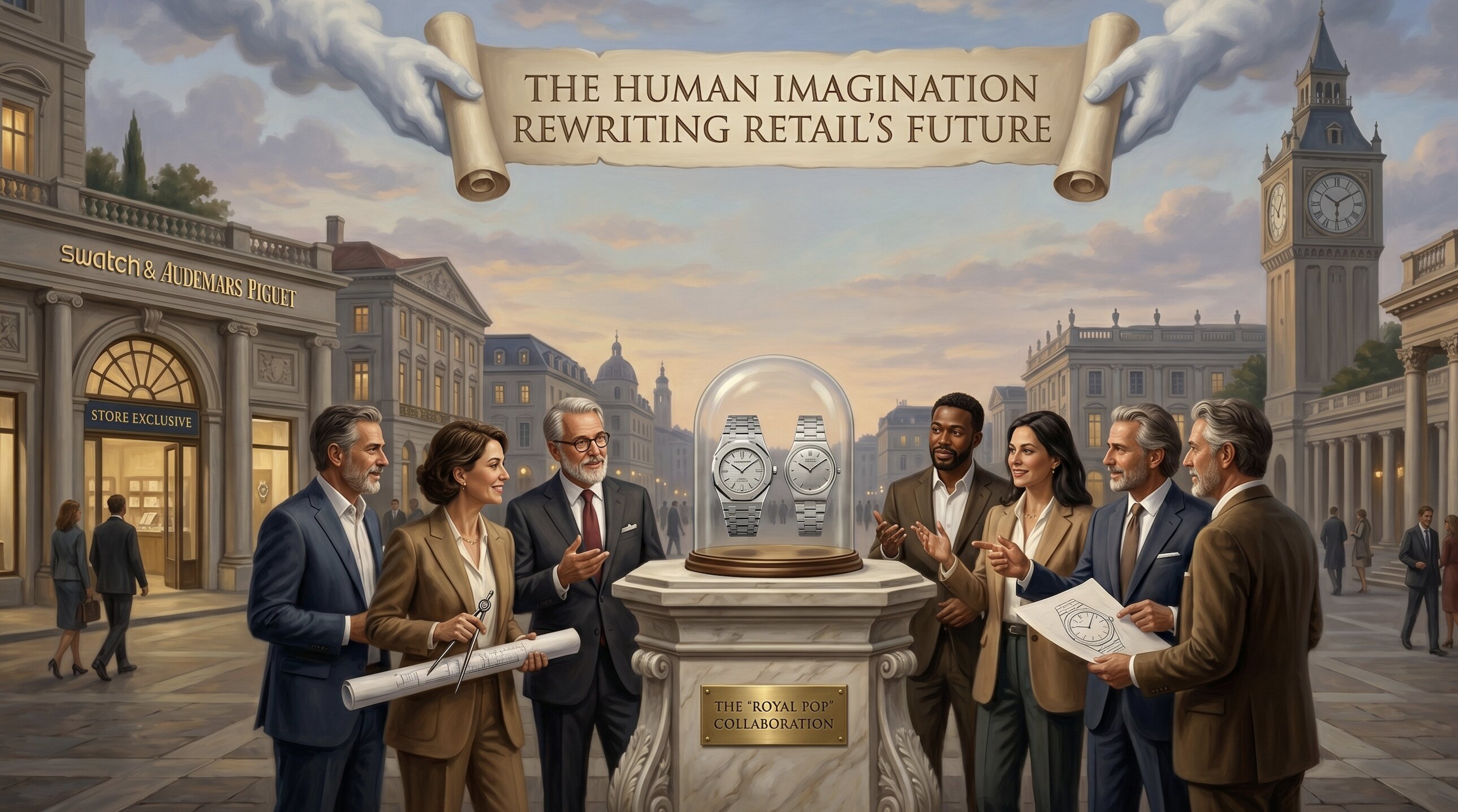
The numbers speak for themselves. The launch generated the hard to imagine amount of 6.5 billion social media impressions within a week and created queues outside Swatch stores around the globe. But the remarkable part was not the marketing campaign. It was the underlying idea.
Who would have expected that luxury heritage and mass accessibility could reinforce rather than dilute each other? Swatch has already tested this idea with its inhouse-brand Omega and the MoonSwatch. The Swatch × Audemars Piguet “Royal Pop” is the first collaboration between two independent enterprises following the same logic: making high-end design accessible while preserving desirability at scale.
Conventional luxury thinking assumes that accessibility erodes exclusivity. These cases suggest the opposite. When guided by clear intent, accessibility can amplify relevance, attention, and long-term brand strength.
That is exactly what future-ready leadership looks like.
"The future does not belong to those who respond fastest to change that is obvious, but to those who have the imagination and discipline to prepare for it before everyone else sees it."
Beyond responding to the market
Many organisations put their efforts to become more customer-centric and data-driven. Both matter. But neither is sufficient when the goal is to create the future rather than react to it.
Responsive leaders wait until trends become visible and then optimise around them.
Anticipatory leaders systematically explore possible futures and make strategic bets and in their way create demand. They recognise that uncertainty is not an obstacle to decision-making but the environment in which competitive advantage is created.
The Royal Pop collaboration did not emerge from following an established trend. It challenged assumptions about luxury, accessibility, branding, and consumer behaviour simultaneously.
The limits of AI
This also highlights an important lesson about artificial intelligence.
AI is exceptionally good at analysing patterns and learning from historical data. But transformative retail ideas often have no historical precedent.
Before the launch, only the name “Royal Pop” was revealed, sparking global speculation. Yet nobody guessed what consumers would actually see. The concept itself lay outside established patterns.
As Nick Hayek, the Swatch CEO, argues: “AI is a statistical system that tells you everything that was but is not looking into the future.” Genuine imagination about what could be remains a uniquely human capability.
The more AI enters retail, the more valuable human creativity, judgement, and strategic foresight become.
The lesson for Retail and Commercial Real Estate
The implications extend well beyond the watch industry.
Retail and shopping centres increasingly compete not only with retail peers and other centres but with every digital alternative available to consumers. Their long-term relevance will depend less on transactions and more on creating experiences that cannot be replicated on a screen.
The Royal Pop phenomenon demonstrates the enduring power of physical retail. Consumers did not simply want to own the product; they wanted to be part of a shared cultural moment. Something a few clicks on a screen can not provide, which is the reason Swatch has decided not to sell it online.
In an era of frictionless e-commerce, that is a powerful reminder that memorable experiences remain a decisive competitive advantage.
Strategic Foresight in practice
Strategic Foresight is often misunderstood as predicting the future. It does nothing of the sort.
Instead, it prepares organisations for uncertainty by exploring plausible scenarios, identifying emerging shifts, and translating those insights into better decisions today.
For retailers and shopping centre operators, this means challenging assumptions before competitors do, experimenting with new business models, and positioning themselves ahead of change instead of chasing it.
The Swatch × Audemars Piguet collaboration is therefore more than a remarkable product launch. It is an illustration of anticipatory leadership and foresight in action.
Maybe we need to question Charles Darwin’s evolution theory and say: The future does not belong to those who respond fastest to change that is obvious, but to those who have the imagination and discipline to prepare for it before everyone else sees it?
More About the Author
Peter Thommen is a former IKEA executive and a veteran in strategy development, strategic foresight and global business services. With a career spanning three decades and multiple continents, Peter specializes in getting (retail) organizations ready for the future, and establish true sustainability – for people, for the planet, and for business. As a long-standing member of the Copenhagen Institute for Futures Studies, he bridges the gap between futures studies and reality to help businesses thrive in an accelerating world.