
What Retail Has Taught Me So Far in 2026
What Retail Has Taught Me So Far in 2026
There is something fascinating about reaching the halfway point of a year in retail.
The daily pressures of trading, staffing, technology implementation, customer expectations, and commercial performance can make it difficult to step back and identify the larger patterns emerging around us. Retail is, by its nature, an industry that operates at speed.
Most leaders spend their time focused on the next challenge rather than reflecting on what the last six months have revealed. Yet reflection matters.
One of the privileges of hosting The Retail Tea Break podcast and working across the retail sector is the opportunity to speak with people from every corner of the industry. Throughout 2026, I have had conversations with retailers, founders, technology providers, consultants, and business leaders who are all approaching the future from different perspectives. While their priorities may differ, many of the same themes continue to surface.
As I look back on the first half of the year, five lessons stand out. None of them is entirely new. In fact, some of the most important lessons rarely are. What has changed is the urgency with which retailers must now respond to them.
1. Artificial Intelligence Is Forcing Retailers to Rediscover Human Value
Artificial intelligence has undoubtedly been one of the defining themes of recent years. However, what interests me most is not the technology itself. It is the questions the technology is forcing us to ask.
For a period, much of the discussion centered on capability. What can artificial intelligence do? How quickly can it analyze information? How much productivity can it unlock? Which tasks can be automated? Those questions remain important, but they are no longer the most interesting ones.
The retailers making meaningful progress have started asking a different question. If technology can perform many routine activities more effectively, where does human value become most important?
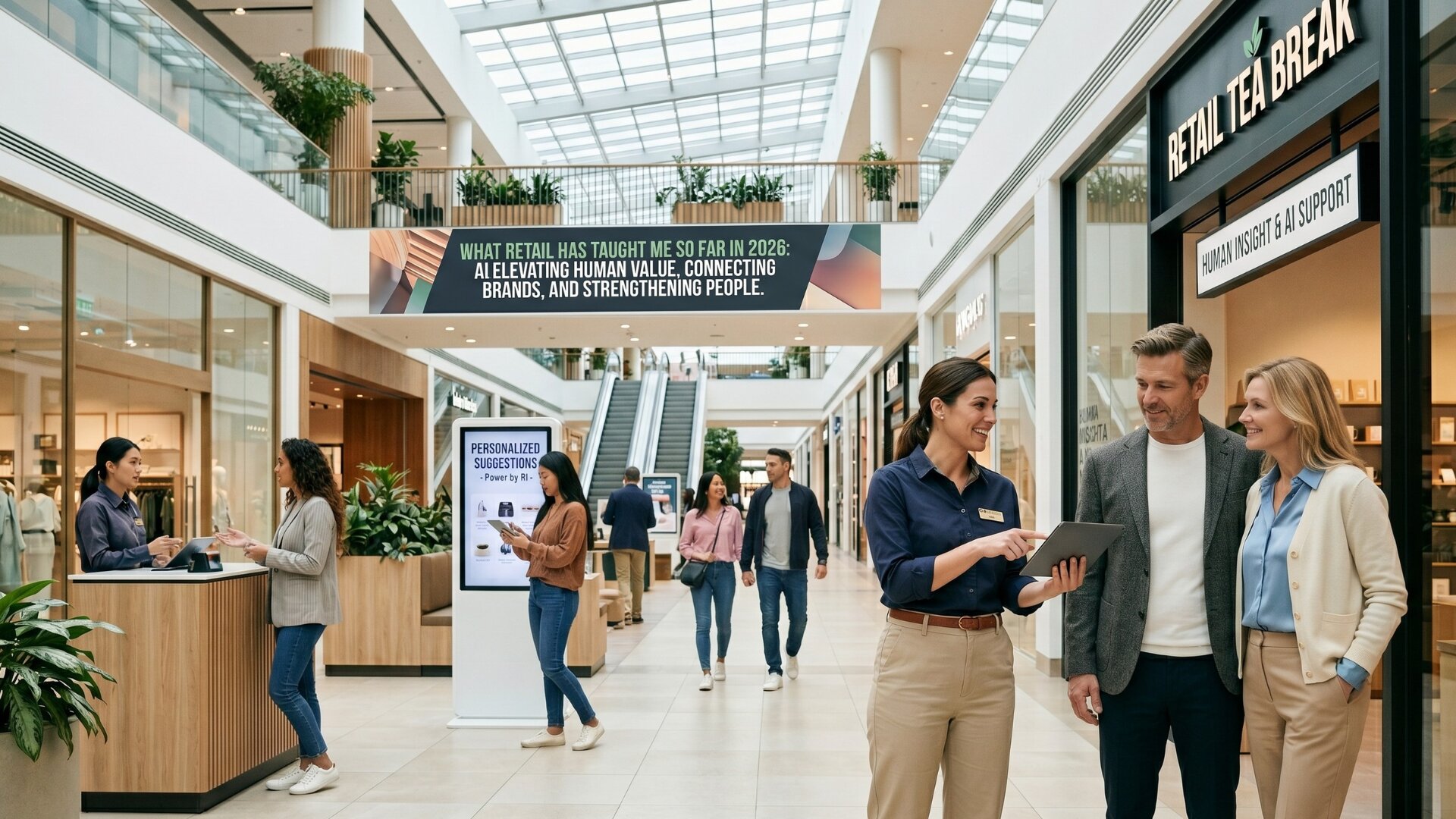
The answer lies in areas that have always distinguished exceptional retailers from average ones: judgment, empathy, creativity, relationship building, leadership, the ability to navigate ambiguity, the ability to understand context, and the ability to make decisions when there is no obvious answer. In many ways, artificial intelligence is not diminishing the importance of people; it’s highlighting it.
The organizations that will gain the greatest advantage from technological advancement will not necessarily be those that invest the most heavily in technology. They will be those who most clearly understand the role that people play within their businesses and empower them accordingly.
"Artificial intelligence is not diminishing the importance of people; it is highlighting it."
2. Organizational Alignment Has Become a Customer Experience Issue
One of the most common frustrations I hear from retail leaders concerns customer experience. They recognize its importance. They invest in it. They measure it. Yet many still struggle to deliver it consistently. However, customer experience is frequently discussed as though it belongs to a particular department. In reality, it belongs to everyone.
Customers do not experience businesses in the way organizations are structured internally. They do not think in terms of ecommerce, marketing, operations, stores, customer service, technology, or supply chain functions. They experience a single brand, and they expect that experience to feel coherent. The challenge for many organizations is that internal complexity often becomes external friction.
A promotion that is communicated inconsistently. A loyalty programme that works differently online and in-store. Customer data that sits in multiple systems. Teams are pursuing objectives that are individually logical but collectively disconnected. These issues are rarely caused by a lack of effort. More often, they are the consequence of organizations evolving faster than their structures.
The retailers creating exceptional experiences in 2026 are not necessarily those with the most sophisticated technology. They are often those who have created the strongest alignment across their teams. They understand that customer experience is ultimately the outcome of organizational behaviour.
3. Clarity Is Emerging as a Competitive Advantage
Perhaps the most surprising lesson of 2026 is that certainty has become increasingly valuable.
Retail leaders are operating in an environment characterized by economic uncertainty, changing consumer behaviours, geopolitical tensions, rapid technological development, and increasing competitive pressure. Faced with so much complexity, the instinct is often to do more: launch more initiatives, introduce more technology, and expand into more channels. However, when I look at the retailers performing most effectively, I see something different. I see clarity.
- Their employees understand the strategy.
- Their customers understand the value proposition.
- Their leadership teams understand the priorities.
They are not attempting to be everything to everyone; instead, they are making deliberate choices about where they will compete and where they will not. In a marketplace saturated with noise, clarity creates confidence. It helps customers make decisions, helps employees focus their efforts, and helps organizations allocate resources more effectively.
4. The Physical Store Has Entered a New Phase of Relevance
For much of the past decade, discussions about retail innovation have focused predominantly on digital channels. The assumption was often that technology would gradually reduce the importance of physical retail. What I am seeing in 2026 suggests something rather different.
The role of the store is becoming more important, not less.
The reason is straightforward. As digital commerce becomes increasingly efficient and accessible, the value of physical retail shifts away from transaction and towards experience. Customers can purchase products through countless channels. What they cannot always access are confidence, expertise, reassurance, inspiration, and human connection.
Retailers are using stores to strengthen relationships, communicate brand values, showcase expertise, and create memorable experiences. They recognize that physical retail provides something that remains difficult to replicate digitally: it creates emotional engagement.
This does not mean digital transformation has become less important. Quite the opposite. The retailers succeeding today are integrating physical and digital experiences more effectively than ever before.
The old debate between online and offline has become largely irrelevant. Customers have already moved beyond it, and retailers need to do the same.
5. The Greatest Differentiator Remains People
Despite all the technological innovation taking place across the industry, one lesson continues to emerge with remarkable consistency: people remain retail's most significant competitive advantage.
Technology can undoubtedly improve efficiency and effectiveness. It can provide insights, automate processes, and unlock new opportunities. However, technology alone does not create trust. It does not inspire loyalty. It does not establish purpose. Those outcomes remain fundamentally human.
What gives me optimism about the future of retail is that many leaders appear to be recognizing this reality. The most forward-thinking organizations are investing not only in technology but also in capability, culture, leadership, and learning. They understand that sustainable success is rarely achieved through technology alone. It is achieved when talented people are equipped with the right tools, supported by the right culture, and united by a clear sense of purpose.
Looking Ahead
When I reflect on these five lessons, a common theme emerges.
Retail's future will undoubtedly be shaped by technology, data, and innovation. However, the organizations that succeed will be those that understand these are tools rather than objectives. The real challenge facing retail leaders is not deciding whether to embrace change. Change is inevitable. The challenge is deciding what should remain constant while everything else evolves.
For me, the answer remains remarkably clear: understand customers deeply and invest in people. Use technology with purpose rather than enthusiasm alone. The retailers that master those fundamentals will continue to thrive, regardless of what the next six months bring. If the first half of 2026 has taught me anything, it is that the fundamentals still matter far more than many people realize.
More About the Author
Melissa Moore is a retail educator and global retail trainer. She hosts The Retail Tea Break, a podcast featuring discussions with retail leaders, innovators, and technology experts exploring the ideas shaping the future of retail. Find it on your favorite podcast platform or subscribe on Substack.