
Clicks, Bricks, and Heavy Lifts: Decoding the Divergent Retail Playbooks of Gymshark and Squat Wolf
Clicks, Bricks, and Heavy Lifts: Decoding the Divergent Retail Playbooks of Gymshark and Squat Wolf
Comparison: Squat Wolf vs Gymshark – Transition from Online to Physical Retail
Both Squat Wolf and Gymshark began as digitally native direct-to-consumer (DTC) fitness apparel brands, leveraging social media, influencer marketing, and e-commerce to scale rapidly. However, their transition into physical retail and approach to customer base expansion reveal both similarities and key strategic differences.
Growth Origins and Brand Positioning
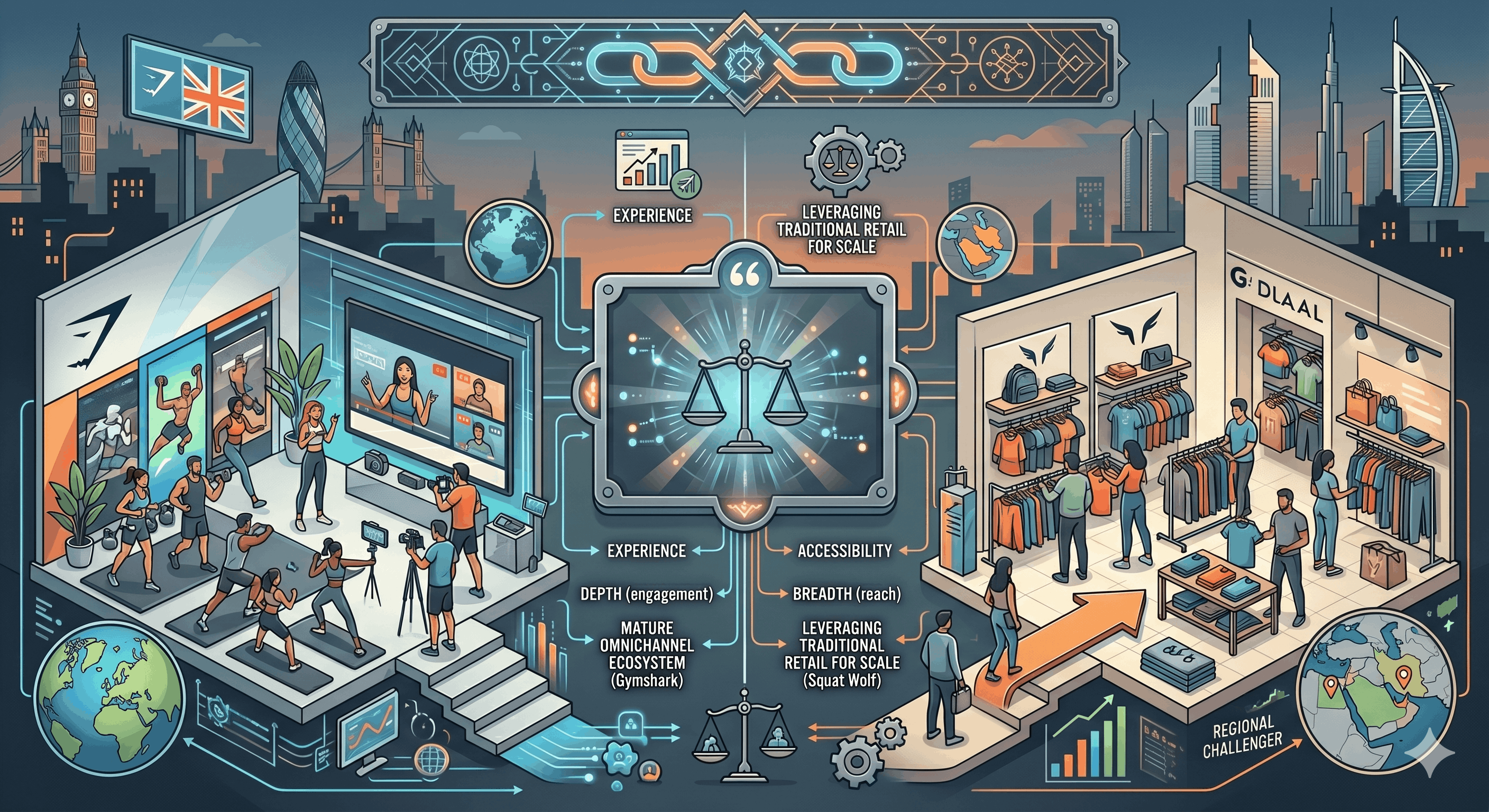
Gymshark (UK-based) achieved global scale much earlier, building an online community through fitness influencers and events. It positioned itself as a global lifestyle fitness brand, whilst Squat Wolf, by contrast, is a regional challenger brand rooted in the UAE, with a strong focus on the Middle East fitness market. Its growth has been more geographically concentrated.
Key difference: Gymshark scaled globally online first, while Squat Wolf is still expanding regionally and using physical retail to accelerate that growth.
"Ultimately, the transition from online to physical retail is not one-size-fits-all; success depends on a brand’s scale, market maturity, and the ability to balance customer experience with operational efficiency."
Approach to Physical Retail (Clicks-to-Bricks)
Gymshark’s strategy:
Opened flagship experiential stores (e.g., London, New York)
Focuses on community, events, and brand immersion
Stores are not just for sales, but for content creation and engagement
Squat Wolf’s strategy:
Opened stores in high-footfall UAE malls
More focused on product accessibility and sales
Physical stores act as a customer acquisition channel
Key difference: Gymshark uses stores as experience hubs, while Squat Wolf leans more toward traditional retail with brand presence.
Customer Base Expansion Strategy
Gymshark:
Already has a global digital audience
Uses physical retail to deepen engagement, not just acquire customers
Expands through community-driven events and brand loyalty
Squat Wolf:
Uses physical stores to reach new, non-digital customers
Targets mall traffic, tourists, and casual shoppers
Physical retail is a key tool for market penetration
Key difference: Gymshark expands depth (engagement), Squat Wolf expands breadth (reach).
Operational and Scaling Challenges
Both brands face similar challenges, but at different scales:
Gymshark challenges:
Maintaining brand exclusivity while scaling globally
High investment in flagship experiences
Ensuring consistency across international markets
Squat Wolf challenges:
Managing high retail costs in premium malls
Building operational expertise in physical retail
Avoiding overexpansion before demand is proven
Key insight: Gymshark’s challenge is global complexity, while Squat Wolf’s is scaling sustainably from a smaller base.
Omnichannel Integration
Gymshark:
Strong integration between online and offline
Stores enhance the digital ecosystem
Focus on data, personalization, and community
Squat Wolf:
Still developing full omnichannel maturity
Needs stronger integration between e-commerce and stores
Opportunity to improve customer journey consistency
Conclusion
While both Squat Wolf and Gymshark illustrate the shift from online to physical retail, their strategies reflect different stages of growth and market positioning. Gymshark adopts a mature, experience-led retail model, using physical stores to strengthen brand loyalty and community engagement. In contrast, Squat Wolf uses physical retail more as a growth and acquisition tool, aiming to expand its regional presence and reach new customer segments.
Ultimately, the comparison highlights that the transition from online to physical retail is not one-size-fits-all. Success depends on a brand’s scale, market maturity, and ability to balance customer experience with operational efficiency.
More About the Author
Alex Andarakis is the Founder and Managing Director of Andarakis Advisory Services, a Dubai-based consultancy specializing in destination strategy, place making, and brand-led transformation. With more than 30 years of senior leadership experience across Unilever, Aujan Coca-Cola Beverages, Emaar Properties, and Omniyat, he brings a rare blend of strategic discipline and creative insight to the world of retail and real estate development.
Since establishing Andarakis in 2010, Alex has led the firm in delivering over 100 high-impact advisory and branding assignments across the Middle East and North Africa. His work spans major retail mall owners, government entities, developers, and large-scale mixed-use projects — helping them evolve from traditional commercial assets into culturally relevant, experience-driven destinations.
Known for his ability to merge data, strategy, and storytelling, Alex continues to shape how modern retail environments compete, differentiate, and inspire the communities they serve.