
We Don’t Have Time to Save Time
Why companies pay for inefficiency every day while still treating digitalisation as a cost.
Summer is over, the children have returned to school, and for adults this is apparently a sign that we must once again become frantic and pressed for time, because the end of the year will be here at any moment.
September Is Not the Problem; Our Established Rhythm Is
A friend said something similar to me today when we spoke on the phone: “You can tell it’s September because the phones have started ringing again.” I have to agree with him, not because the phones have actually started ringing, but because this way of thinking is apparently already deeply rooted in our minds.
It is understandable that during the summer, particularly during the school holidays, we feel more relaxed and at ease, while by the end of August we already start worrying that the craziest period of the year is approaching. The summer school holidays last just over two months, but the percentage of working people who are actually absent throughout this entire period is very small. This means that we should still be working.
Personally, I would say that this is primarily a long-standing pattern that we adopted in childhood and later transferred into our business lives. At the same time, because of the ever-faster general pace of life, the summer slowdown suits us, and we need it. I recognise this in myself as well, as I read two books this summer, each more than 500 pages long. Crazy.
Rather than focusing on the summer rhythm itself, I would therefore like to address this long-standing pattern of behaviour and business practice. Habit is an iron shirt, as the saying goes, but in an era of rapid digitalisation, this iron shirt is becoming increasingly expensive because it causes companies to retain procedures for which faster, more accurate and often cheaper solutions have long existed.

We also used the summer to organise our sales process. By using an AI agent, we automated the search for and classification of potential clients according to certain criteria, their inclusion in the sales funnel and part of the initial marketing communication. This did not eliminate the need for people and personal relationships, but it significantly reduced the time we previously spent researching the market, reviewing contacts and performing repetitive tasks.
This does not mean that every single task should be automated or that AI can replace judgement, experience and personal relationships, but it makes no sense for people to continue spending hours on procedures that a suitable tool can perform more quickly and with less possibility of error.
In this context, I cannot overlook three statements I recently heard that could be placed in the category of “habit is an iron shirt.”
When Manual Work Becomes an Invisible Cost
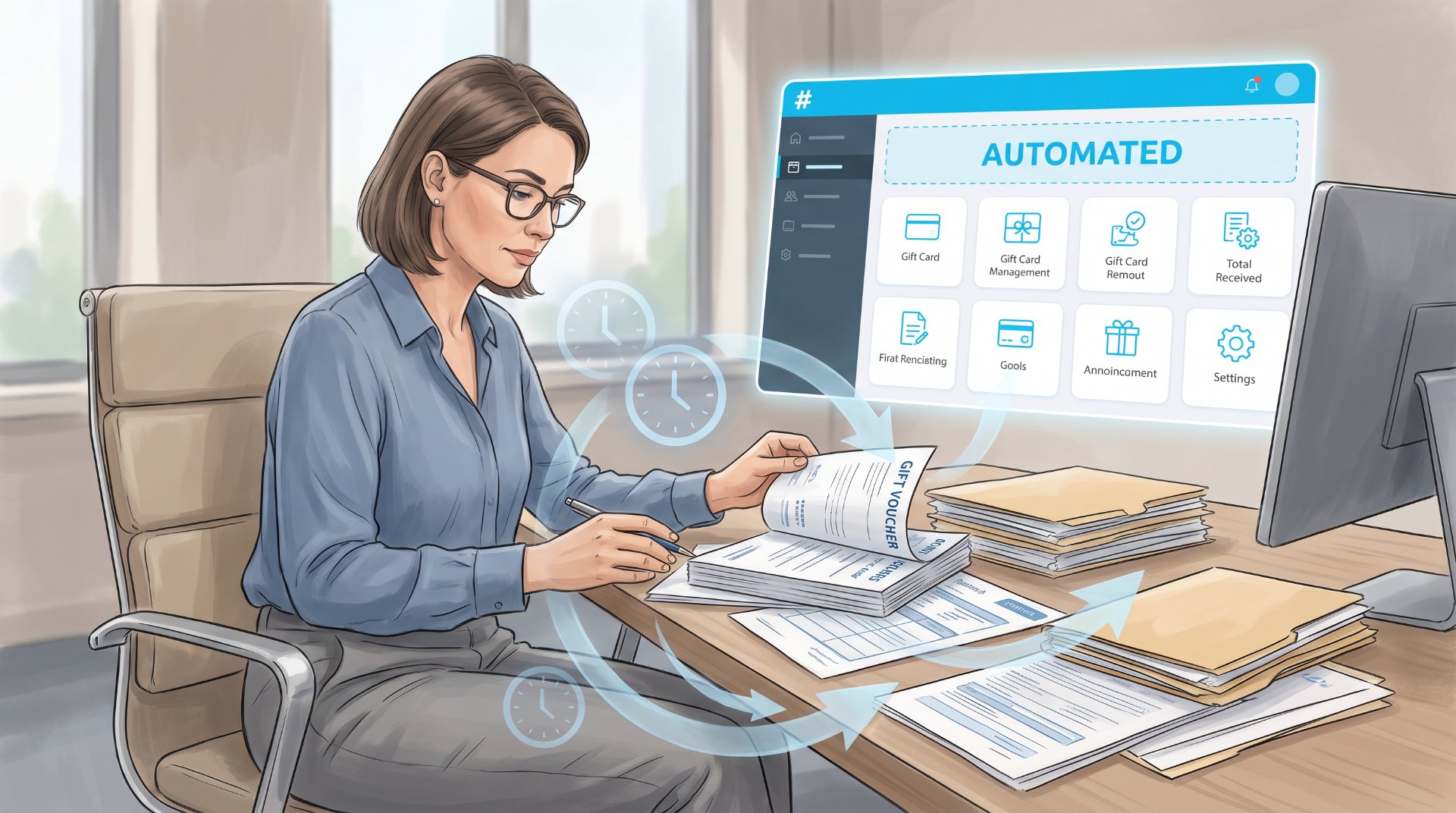
The first example concerns the recording of gift vouchers. One shopping centre sells a large number of vouchers, but because its system is not digitalised, redeemed vouchers must first be counted at each individual store and then checked again by the shopping centre’s management. Receipt forms must be prepared and signed, data must be recorded manually, and individual payment orders must be prepared for the retailers.
When we add up the time required for the entire procedure, it apparently requires practically one full-time person. When I pointed out the amount of work and the cost, I received a response that was made somewhat jokingly but was probably much closer to the truth than we would like to admit: “They’re on the payroll anyway.”
This response is based on the dangerous assumption that the time of a person who is already employed is free. It is not. Every hour they spend counting vouchers, copying data and preparing payment orders is an hour they could devote to something else, to analysing results or improving services. Alternatively, that person might not be needed at all, allowing the company to avoid an unnecessary cost.
The second example comes from the world of event organisation. Participant registrations are entered into Excel manually, emails are sent individually, and upon arrival, each participant is located on a printed list and ticked off. Invoices must be prepared separately, and thank-you messages must be sent after the event, provided there is any time left to do so.
Errors can quickly occur in such a process: one message may be sent twice, another may be forgotten, while queues and unnecessary stress arise upon arrival. When I suggested a digital tool that would connect registration, payment, invoicing, communication and attendance tracking, the response was similar to the one in the first example: “No, we already have an employee for that, and the event is small anyway.”
We Don’t Have Time for the Solution Because We Are Too Busy with the Problem

In a way, I can understand this because I also find myself putting out fires and dealing with something urgent but not important, instead of focusing on something important that is not yet urgent at that moment. The problem arises when this way of working changes from an occasional exception into a permanent state. There is always a new fire, a new client or a new deadline that causes us to postpone the change once again.
It is a matter of priorities and habits, and often also the fact that we do not implement change until the existing way of working begins to hurt enough. As long as the process somehow continues to function and people resolve errors through additional effort, it seems easier to carry on as before.
Of course, not every form of digitalisation is inherently good. If we simply move a poor process from a sheet of paper to a screen, we have not solved much. First, we must understand why we perform a particular task and what result it must produce, and only then choose a tool that will simplify or automate the process.
Digitalisation and AI are not intended simply to replace people, but to take away tasks for which their knowledge and judgement are not needed at all. A person who counts vouchers, copies registrations into Excel or manually sends the same messages over and over may indeed “already be on the payroll,” but that does not mean their time has no value. The company could use it for something that would improve customer relationships, increase sales or solve a problem for which there is currently never enough time.
The greatest obstacle to digitalisation is usually not the price of the software, the complexity of the technology or the lack of available solutions, but the willingness to question a way of working that we have accepted as normal for years.
While we wait for it to hurt enough, others are using the same time to improve their processes, better understand their customers and develop new services. The iron shirt may feel comfortable because we are used to it, but that does not make it any less iron. Companies that do not take it off in time will not fall behind because they lacked access to technology, but because they believed for too long that they did not need to change.
Jurij Triller