
Growth Comes at a Cost
The autumn equinox and equilux are now behind us – that brief moment of the year when day and night are almost equal in length. It was precisely this almost perfect, yet not entirely precise balance that made me wonder: does our life really need to be 50 : 50, or is it more important to recognise what drains us and what gives our energy back?
This year, autumn caught me slightly unprepared. Even though the calendar made it clear that summer was over, for a while I continued behaving as though September were simply an extension of it. My sandals were still within reach, while my jacket was stored somewhere out of sight.

Then, one morning this week, I quite casually left for work wearing sandals and no jacket while it was less than ten degrees outside. I am not sure which part of this story is worse: the fact that I did not check the temperature, or the fact that, once I was already outside, I decided I was not going back. If I had already dressed according to my own weather forecast, apparently I was going to live by it too.
Autumn in Ljubljana brings something else I have never particularly liked – fog. But often, all it takes is going a little farther or a little higher, and the sun is waiting above it. Down below, it looks as though the whole world is grey, while a few kilometres away you realise that the sun has not disappeared at all – you simply cannot see it from where you are currently standing.
Last week, we took five days off. We were simply exhausted and felt that it was wiser to stop now than to wait until our bodies stopped giving us the choice.
Perhaps I used to associate rest much more closely with the calendar: holidays belong in summer, weekends are for resting, and evenings are not for work. Almost like a good Excel spreadsheet. The problem is that the body does not read Excel and does not care that the project is important or that we will “just get through one more week”.
Only a few days after the holiday, I returned to the opposite rhythm: work is becoming more intense, weekends are increasingly spent working, and at the same time I am accepting things outside my comfort zone and learning new things.
And I like it. I feel that I am growing professionally, but I am also seeing something more and more clearly that we perhaps do not talk about enough: growth comes at a cost. A new project can be a wonderful opportunity and at the same time require more concentration, a journey can be beautiful and exhausting, and a professional leap also brings new responsibility.
In physiology, there is a concept called allostasis – maintaining stability through adaptation to change. The problem arises when there are too many demands or when there is not enough time afterwards to recover. This is when we speak of allostatic load – the price the body gradually pays for constant adaptation.
So the problem is not that we step outside our comfort zone. Without doing so, there is no development. The problem arises when, after each step outside it, we no longer have anywhere to return to.
The Counterbalance Is Not Always Rest
We often associate recovery with stillness: sleep, the forest, silence and a switched-off phone. But my counterbalance to an intense period is not always rest.
This weekend, I have friends, a concert, music, conversations and probably less sleep ahead of me than any health-tracking app would recommend. And yet I know that many of these things will recharge me.
Not all activities are the same simply because they occupy space in our calendars. Some drain us, others recharge us, and some do both: they tire us physically while also giving back a sense of closeness, joy or meaning.
I experience nature-based therapies in a similar way. They are work and require preparation and responsibility, but afterwards I often feel that I have given energy rather than lost it. That is why the more important question for me is: what drains me, and what, despite the effort involved, also recharges me?

Sometimes that counterbalance is neither a holiday, nor the forest, nor an entire day off. I am happy simply when my husband and I manage to find ten minutes in the morning to have coffee together on the balcony, especially if we also manage to catch some sunshine. It does not happen every day, especially when our schedules start pulling us in different directions early in the morning, but perhaps that is precisely why those ten minutes are so valuable. They do not eliminate tiredness, they do not erase our responsibilities or make the rest of the day less demanding, but for a short while they take us out of the role of two people organising work, home, schedules and all the other things adults apparently organise endlessly, and bring us back to something much simpler – the two of us having coffee.
Such moments remind me that balance does not necessarily have to look like a dramatic cut in the calendar. Sometimes it is hidden in coffee together, a short walk, a few minutes in the sun or a conversation without checking the time. What matters most is that the things that bring us back to ourselves are not the first things we remove when our schedule becomes demanding.
One time, the answer will be the forest and peace; another, friends and a concert; another, five days off. Recovery does not necessarily mean the absence of activity, and not everything that tires us is automatically bad for us.
If Something New Enters Our Life, Space Has to Be Created Somewhere
Over the past few months, some of the things I started have begun to produce results. Professionally, I am moving into new areas, the therapies are developing and new opportunities are appearing.
When something begins to succeed, a calmer period often does not follow. Instead, there is more responsibility, more decisions and more things to which we could say “yes”. It is easy to confuse growth with constant addition, as though everything new could simply be placed on top of everything that already exists.
But somewhere, there is a limit to our capacity. If something new enters our life, space has to be created somewhere.
This brings me back to the equinox and equilux. We imagine the autumn equinox as a perfect balance between day and night, although in reality it is not quite so. This small astronomical “imperfection” nicely challenges our need for our own balance to look perfect too.
How often do we try to live according to the 50 : 50 principle? If we have worked a lot, we should rest just as much. If one weekend was spent working, the next one should be free. As though one day we could perfectly balance every part of our lives.
Nature does not concern itself with this. The days are getting shorter, some things are ripening, some are completing their cycle, while others are already storing energy for winter. Nature does not have a KPI for the number of new leaves produced in December.
The digital world, however, has no seasons. Email does not care whether we are tired, the calendar does not know that we slept badly, and our phone will not reduce the number of notifications on its own.
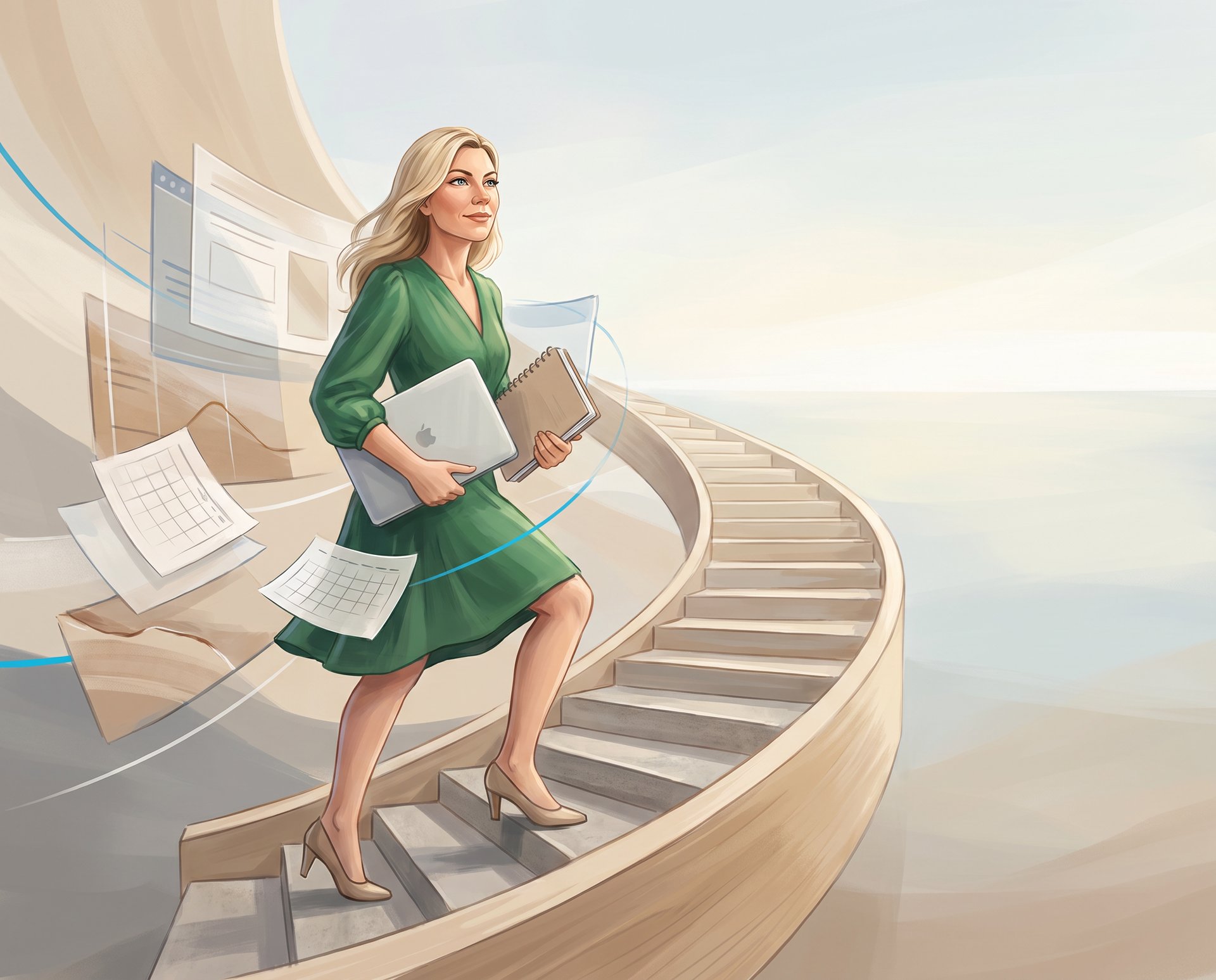
Technology enables me to learn faster, find information when I need it, work from different places, meet people and accept opportunities that would once have been far more difficult to access. The problem begins when we quietly turn possibility into obligation. I can answer immediately, I can just finish this one last thing, I can open my laptop on Sunday, I can check my email while on holiday and I can do one more thing before bed. Of course I can. But “I can” and “I have to” do not mean the same thing, and lately I have had to remind myself of that more often.
Perhaps that is also why I am beginning to like Ljubljana's fog a little more. When you are standing in the middle of it, it is easy to believe that everything is grey, and then you go a little higher and realise that above that layer, the sky has been clear all along.
Of course, we cannot solve every problem by going for a walk and looking towards the sun. Some problems need to be solved, some boundaries need to be set, and sometimes we need a conversation, a doctor, a therapist, help or several genuinely good nights of sleep.
Sometimes, however, we simply need a little distance: a walk, sleep, coffee on the balcony or a conversation with someone we trust. Not every fog means that we have lost our direction; sometimes we simply do not yet have a good enough view.
That is why balance feels less and less to me like a final state and increasingly like the ability to notice early enough when I have been leaning too far in one direction for too long. One week, work will need more of me; another time, I will need more of myself.
This autumn, I have a great deal of work and new challenges ahead of me, and I am looking forward to them. I am equally looking forward to friends, the concert, the therapies, nature, morning coffee with my husband and those moments when I do not have to prove anything.
There will almost certainly not be a perfect 50 : 50. And I am no longer sure that there should be.
I still have not completely put my sandals away, although I have at least found my jacket, which for now I consider perfectly respectable progress. When Ljubljana disappears beneath the fog again, I will try to remember that the sun has not disappeared simply because I cannot see it at the moment.
Perhaps balance works in a similar way. We do not have to calculate it perfectly; perhaps it is enough to recognise what gives us energy, what drains us and what we need to make a little more room for.
Mila Triller