
Beyond the Store: Why Retailers Must Diversify to Survive
Beyond the Store: Why Retailers Must Diversify to Survive
For decades, retail operated on a relatively simple formula: source product, manage inventory, optimize store footprint, and drive volume. Growth came from more stores, more categories, and more transactions. But today, that model is structurally fragile.
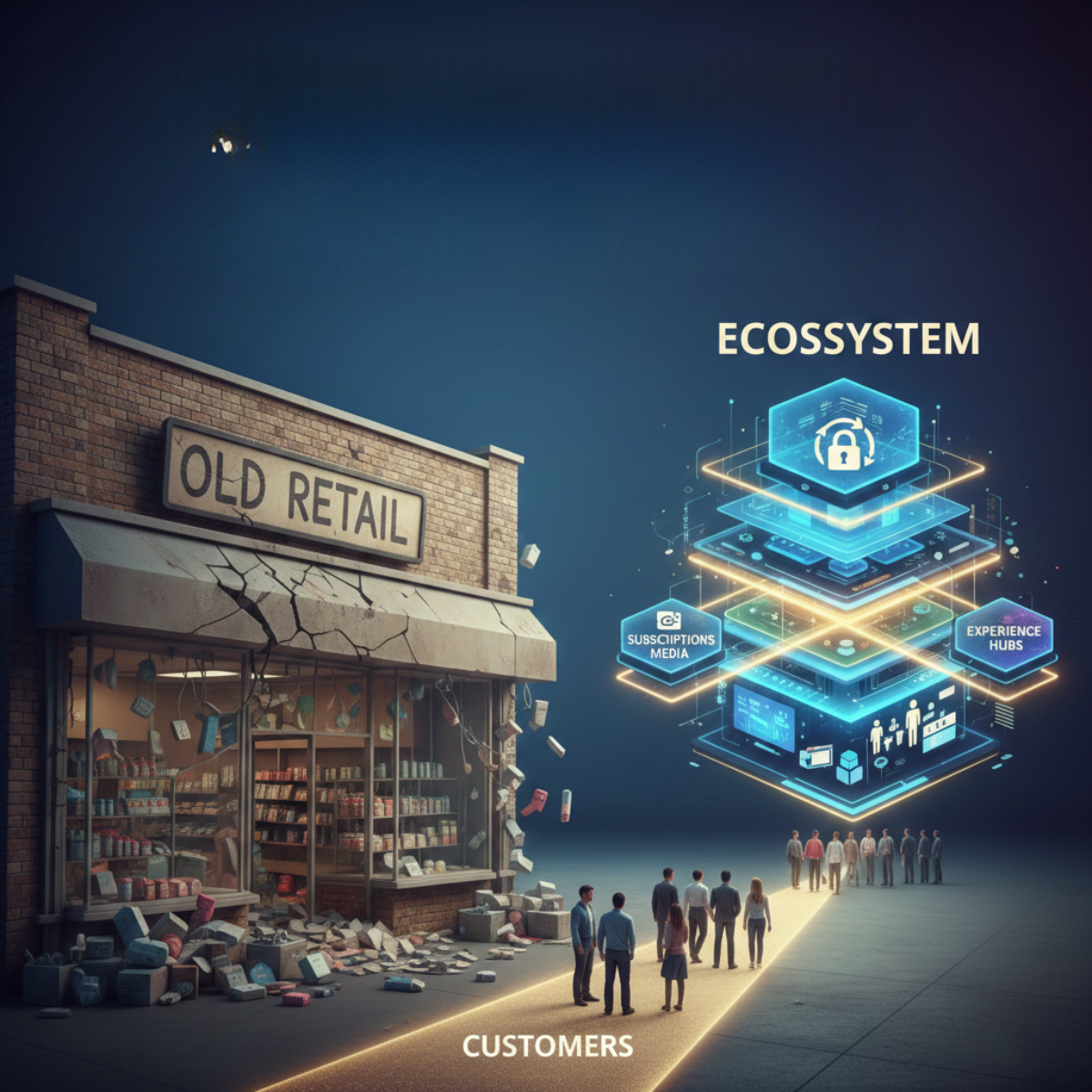
Thin margins, volatile consumer demand, rising fulfillment costs, price transparency, and digital competition have exposed the limits of relying solely on product sales. In this environment, diversification is no longer an expansion strategy — it is a resilience strategy.
The retailers that will lead the next decade are not just merchants. They are ecosystem builders
“The retailers that will lead the next decade are not just merchants. They are ecosystem builders.”
The Structural Pressure on Traditional Retail
Core retail economics are under strain. Gross margins are compressed by online price comparison and promotional intensity. Fixed costs centered on leases, labor, logistics are increasing. Inventory risk has increased amid supply chain disruptions and demand unpredictability. Meanwhile, consumers are less loyal and more value-conscious.
Relying on a single revenue stream through product markup leaves retailers exposed to these forces. When traffic slows or discounting increases, profitability erodes quickly.
Diversification changes that equation.
What Strategic Diversification Really Means
Diversification is not simply adding more SKUs or expanding into adjacent categories. It is about layering complementary revenue streams around the core customer relationship.
There are four primary levers:
1. Revenue Stream Diversification
Retailers are increasingly monetizing beyond the transaction. Subscription models such as Amazon Prime and Walmart+ generate recurring revenue and deepen loyalty. Retail media networks have become a high-margin growth engine, with major retailers turning shopper data into advertising platforms.
These streams are often higher-margin and less inventory-intensive than traditional retail sales.
2. Product Mix Diversification
Private label and exclusive brands offer greater margin control and differentiation. Target, Costco, and grocery chains have demonstrated that owned brands can build loyalty while improving profitability. By shifting mix toward controlled brands, retailers reduce reliance on vendor pricing power and promotional pressure.
3. Channel Diversification
Omnichannel integration is now non-negotiable. Retailers that combine physical stores, e-commerce, marketplaces, and even wholesale partnerships are better positioned to capture demand wherever it emerges. Stores increasingly function as fulfilment hubs, reducing last-mile costs and improving inventory utilization.
Channel diversification also spreads risk across multiple customer touchpoints.
4. Experience Diversification
The most forward-thinking retailers recognize that experience drives retention. In-store services, events, loyalty ecosystems, and community engagement transform the store from a transactional space into a relationship platform. This increases lifetime value and raises switching costs.
The Financial Case
Diversification strengthens retail economics in three critical ways.
First, it improves margin mix. High-margin services, advertising, subscriptions, and private labels elevate blended profitability.
Second, it reduces volatility. Recurring revenue smooths seasonal swings and buffers demand shocks.
Third, it increases customer lifetime value. The more integrated the offering, the more embedded the customer relationship becomes.
In capital markets terms, diversified revenue streams can support higher valuation multiples due to improved predictability and reduced risk concentration.
The Risks of Overextension
However, diversification without discipline can destroy value. Expanding too broadly risks brand dilution and operational complexity. New ventures require capital, management focus, and execution capability. Poorly aligned adjacencies can distract from the core business rather than strengthen it.
The goal is not expansion for its own sake. It is focused adjacency.
The most successful retailers diversify in ways that reinforce their core value proposition. A retailer known for convenience should expand into services that enhance convenience. A retailer known for expertise should monetize that expertise through consultation or premium offerings.
Strategic coherence matters more than breadth.
From Retailer to Platform
The future of retail belongs to businesses that view themselves not merely as sellers of goods, but as platforms anchored in customer relationships. Product remains central — but it is no longer sufficient on its own.
Diversification, done strategically, transforms retail from a fragile margin model into a multi-layered ecosystem. In a market defined by volatility and competition, that shift is not optional.
It is the difference between reacting to disruption and building durability.
More About the Author
Alex Andarakis is the Founder and Managing Director of Andarakis Advisory Services, a Dubai-based consultancy specializing in destination strategy, place making, and brand-led transformation. With more than 30 years of senior leadership experience across Unilever, Aujan Coca-Cola Beverages, Emaar Properties, and Omniyat, he brings a rare blend of strategic discipline and creative insight to the world of retail and real estate development.
Since establishing Andarakis in 2010, Alex has led the firm in delivering over 100 high-impact advisory and branding assignments across the Middle East and North Africa. His work spans major retail mall owners, government entities, developers, and large-scale mixed-use projects — helping them evolve from traditional commercial assets into culturally relevant, experience-driven destinations.
Known for his ability to merge data, strategy, and storytelling, Alex continues to shape how modern retail environments compete, differentiate, and inspire the communities they serve.