
We Buy Smarter. They Scam Us Even Smarter.
Black Friday is approaching. The day when we will massively buy things that we may not need at all, and then brag about how much we have saved. The merchants will be satisfied, the buyers as well. We will all be winners. At least until we look at the bank account.
This year, however, we have a new assistant in shopping. Artificial intelligence.
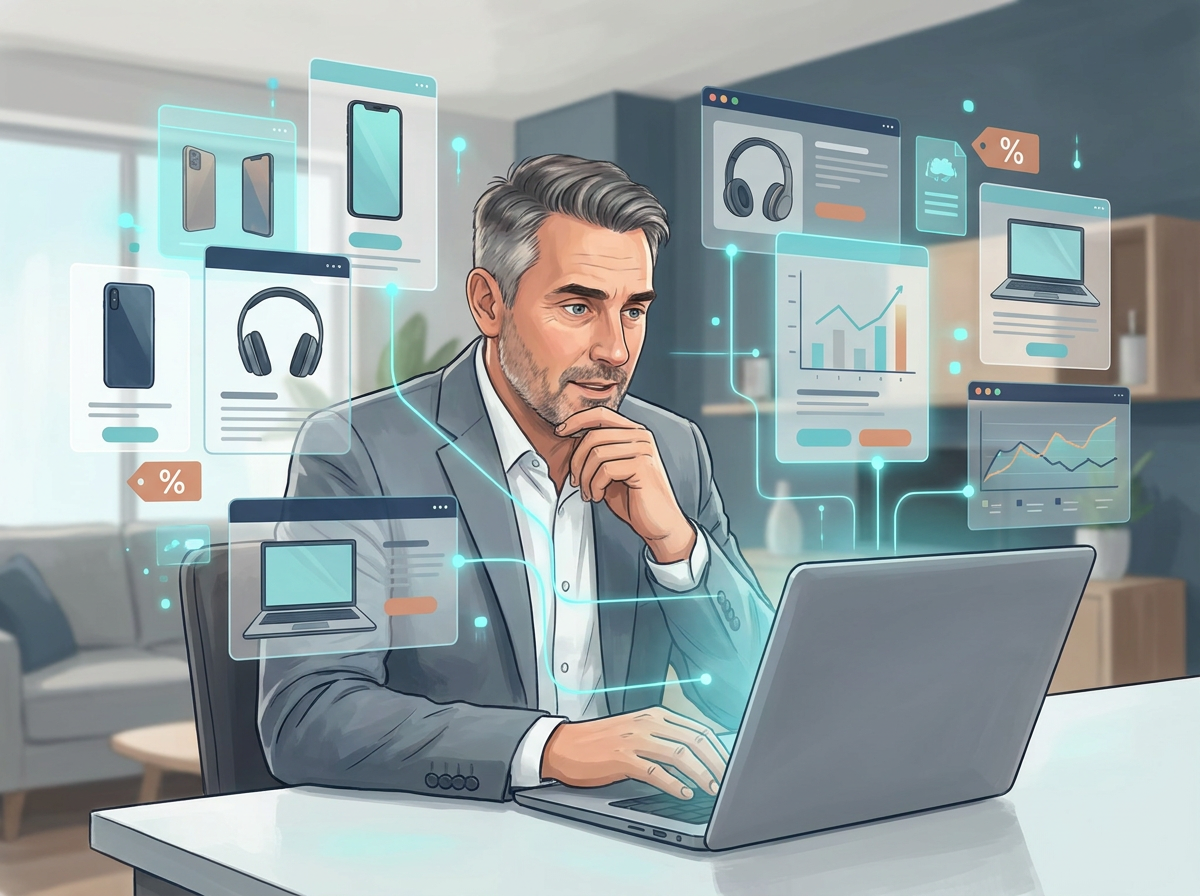
AI can find us the best offer, compare prices, advise on product selection and now even help pay the bill. Wonderful. Finally someone who can do all that boring and above all time-consuming search instead of us.
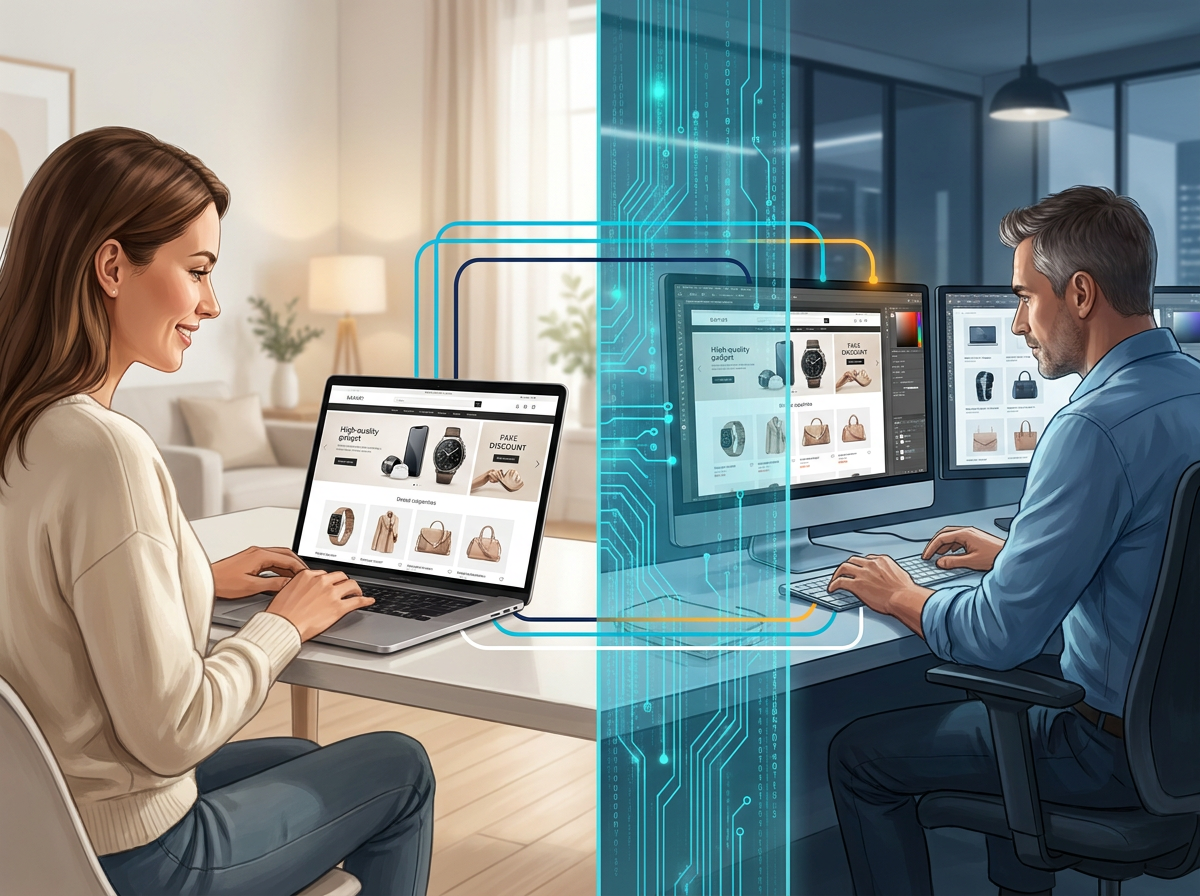
The problem is only that the same technology is also available to those who simply want to steal our money – through fake websites that are set up with AI just to sell with incredible discounts. The page of course looks wonderful.
If we thought that with artificial intelligence we would finally become smarter buyers, I fear that the scammers have become smarter just as quickly. We, on the other hand, are becoming more “stupid” in certain things, since we no longer want to think with our own head. AI of course knows everything. If it makes a mistake, it says: “I apologize, you are right.”
Black Friday and AI Shopping: Who Are We Even Selling To Anymore?
In the past, to buy a product we visited a few stores, compared prices and decided. Then the internet came, which simplified everything for us. Or complicated it, depending on how much time we are willing to spend searching for the best product.
Today we have taken another step forward.
ChatGPT, Gemini and similar systems are already helping us choose products. AI can compare offers, monitor prices and suggest a purchase to us. OpenAI has already introduced direct shopping in ChatGPT (Instant Checkout), which allows payment through AI agents, of course with user confirmation.
The next step? AI will make the purchase almost by itself. But here an interesting question arises: if artificial intelligence chooses products instead of us, who will the merchants sell to in the future? To people or to algorithms?
Until now we have paid for better positions on Google, advertising and brand recognition. Now we have already started competing primarily for which product the AI will recommend to its user. And will this recommendation really be the best for the buyer?
Not long ago I typed into Gemini “what do you know about SOS” and then about the various solutions we offer. Wow, it reads super. Really nice. Only one problem – quite a few features we (still) don’t have, but it just made them up because it sounds better.
Let me tell another interesting story that is quite funny or even a bit sad. We also offer a solution for web chatbots – text or phone. We are just testing one that we made for a larger company, present in Slovenia and also in other countries. When we were reviewing what the questions and answers were like, a person caught my eye who was actually convinced that at midnight they were talking to a human. Of course the interlocutor was quite rude, and in the end wrote that he didn’t have time to debate all night. Everything is definitely going in that direction. Soon we won’t even know if we are talking to a live person or not.
It is quite likely that in the future the buyer’s AI and the merchant’s AI will negotiate about the price. I’m really curious who will be more satisfied in the end. Probably both algorithms. For the buyer I’m not entirely sure.
AI as a Business Assistant – Unfortunately Also for Criminals
Artificial intelligence has made an incredible leap. Today almost anyone can set up a convincing website in a few hours, prepare professional ads, create product photos and write excellent sales texts.
Once we recognized fake online stores by terrible grammar, suspicious photos and strange web addresses. Today everything can look completely professional. Even worse, with AI we can also create convincing fake voices and videos.
And then we have the DARS case. It is even sadder that here it wasn’t even necessary to use advanced AI, but only “ordinary” phishing. An email with a polite request to transfer the funds to another account, because they had supposedly changed it. The company that manages Slovenian motorways paid approximately 1.8 million euros to the wrong account due to such a scam. According to the latest information, they managed to secure most of the money. But still.
We are not talking about an individual who ordered a suspiciously cheap phone at midnight. We are talking about a large organization with a finance department, employees and established procedures. And it still happened.
What is interesting here is that attackers don’t necessarily have to break into a complex information system. Sometimes a convincing message and someone who believes it is enough – without even checking the domain of the sender’s email address.
In the past, scammers mainly needed ingenuity. Today artificial intelligence helps them with that. Naivety, however, has apparently remained our domain. Maybe it’s something else and not naivety, but I would rather not write about that ...
Cybersecurity: Less Blind Trust, More Common Sense
With all these stories, the question quickly arises how to protect ourselves at all. Will we have to check every online store, every email and every artificial intelligence recommendation? To some extent yes. But above all we will have to change the way of thinking.
Technology can help us check transactions, control access, monitor irregularities and prevent abuses. The key, however, are clear procedures, divided responsibilities, regular password changes and caution when connecting devices to the internet.
A good reminder are the recent cyberattacks in France, when attackers remotely turned off refrigerators in stores and destroyed stocks. And it wasn’t even a movie-like intrusion through hidden software vulnerabilities – the controllers were simply connected directly to the public internet with factory passwords, and AI only helped the attackers scan the web faster and find unsecured targets.
The same applies to financial processes, for example changing a business partner’s bank account. If someone sends you a message that they have a new account from today, it’s really not a bad idea to call them. On the number you already know – not the one written in the suspicious message.
Just today I was arranging new insurance for the software solutions we offer, to insure ourselves and our clients. And what was the main additional offer? Exactly protection against cybercrime. Everything is connected in some kind of spiral: every technological advance brings new opportunities, immediately after it come people with “slightly less good intentions”, which again creates the need for new protections and insurances.

This also applies to everyday shopping. If we find a store that offers incredible discounts, it is worth checking who is behind it. Security is not something that is guaranteed by the nice appearance of the website. And even the lock next to the web address does not mean that the company is honest.
In the development of digital solutions we often talk about functionalities, user experience and speed. Security, however, is the topic that no one can avoid. Especially when it’s already too late.
The most expensive security solution is usually the one we decide on only after an incident.
Why the Cheapest IT Solution Is Often the Most Expensive Decision
Black Friday is interesting also from another perspective. We all look for the best price. And there is nothing wrong with that. I myself see no reason why I would pay more for the same thing if I can get it cheaper. But in business and technological decisions we sometimes focus too much on the initial price.
Today, with the help of artificial intelligence, we can relatively quickly and cheaply develop an application, online store or some other digital solution. But working code does not yet mean a reliable system.
What happens when the system fails? When a security incident occurs? When the solution needs to be adapted to new legislation or connected to other systems? When payment problems arise and there is an dissatisfied customer on the other side?
Then it becomes much less important how much we saved on the initial offer. In business, the quality of cooperation is not shown when everything works – then we are all excellent partners. It shows when something doesn’t work. When it is necessary to take responsibility, find a solution and sometimes admit one’s own mistake.
In solutions that manage transactions, data and business processes, the client must always understand who has control over his money, data and systems. A good technological partner does not create a dependency that the client does not understand, but enables him control and transparency.
Today even AI can write an application for you. It is much harder for it to provide you with a partner who will answer the phone in five years when something goes wrong.
Trust as a Competitive Advantage That AI Does Not Know How to Sell

In business I have experienced many times – and I also personally advocate this –, that the most important part of cooperation is the relationship that you build over the years.
When you know your partner well enough that you can tell each other things that others might not want to hear. When a problem arises, the search for the culprit does not begin, but the search for a solution.
Sometimes such a relationship is worth significantly more than the best price.
It is interesting that companies are investing more and more in technology for managing customer relationships. CRM, loyalty programs, automated communication, data analytics – all these are excellent tools.
But what good is a system that knows almost everything about the customer if no one contacts her when she needs help? Or if we use the data only to sell her another product at all costs? Technology can help build better relationships, but it cannot replace responsibility and a sincere desire for long-term cooperation.
AI can help us write an excellent offer. The problem arises when we have to fulfill everything we promised.
Technology can be bought by anyone. Trust cannot.
In a few days it will be Black Friday. Some of us will be buying, others will be looking for the best offers, still others will leave the shopping to artificial intelligence. Someone will buy excellently. Someone will overpay. Someone might even fall for a scam.
Technology will play an ever greater role in all this. But personally I am convinced that in the future it will not be the companies that will have the most artificial intelligence that will win, but those that will know how to use it correctly. Companies that will understand that digitalization is not only automation of processes, but also responsibility towards people who trust them with their data, money and business.
Because technology can be bought by anyone. Today it can even be developed by oneself with some knowledge and appropriate tools. But you cannot buy trust. You build it over years, but you can lose it in a few minutes.
And if at the end I return to Black Friday: maybe this year we will really find excellent discounts on phones, TVs and computers. Maybe AI will even help us find the best offer.
There will probably be no discount on trust. Although given today’s marketing tricks, I wouldn’t be surprised if someone soon offered us that too.
Jurij Triller