When the lights go up and black tags take over the shop windows: What do shopping destinations really sell?
At this time of year, I love the glow of festive lights, the warmth of decorated spaces, the scent of cinnamon and all the little winter charms. I love watching people — how they move through the crowd, each carrying their own small, quiet reason for being here. Sometimes it reminds me of a December forest: cold, silent, yet full of invisible activity. And while the forest rests in calm, shopping centres overflow with chaos. Black tags, discounts, “last chance”, everything flickering and shimmering, inviting us to buy far more than we truly need.
But right in the middle of that chaos, I love observing what isn’t immediately visible. Because shopping destinations — whether the biggest centre in the city or a small retail park — now sell much more than discounts. They sell belonging. They sell moments. They sell that brief feeling when a person suddenly feels a little lighter, a little happier, a little less alone. And this year more than ever, we’re all in the same rhythm: too much noise, too many promotions, too much of everything. That’s why I believe people don’t come to shopping centres only to buy something. They come because they’re looking for something to feel.
Shopping destinations today sell far more than goods.
November’s single days are behind us. And the black month, black week, black Friday… A discount lasts until Sunday, but the feeling — much longer.
The line between tourism destinations and shopping destinations is becoming slimmer every year. It may sound bold, but it proves itself over and over again: the two function in surprisingly similar ways. Both offer structure, a story, orientation, safety, continuity.
People come for the offer, but they return because of the atmosphere. Whoever understands that — wins. Because people don’t return for the lowest price, but for how they felt while they were there.
I’ll admit, I’m drawn to centres that make sense: where you can navigate without stress, where the lights don’t attack you, where the space guides you rather than pushes you. Places where you can sit down, breathe, check your messages — without feeling like you're on autopilot.
What puts me off are aggressive messages, fake urgency and “promotions” that last longer than the season itself. Crowds that feel strategically manufactured. And spaces designed to trap me rather than understand me.
Yet what surprises me every time is how enormous a difference a very small gesture can make.
Here’s an example that helped me understand what truly turns a shopping centre into a destination. Recently, in one centre, I saw an older woman standing with her arms full of bags, searching for a bench. There wasn’t one. People hurried past, each in their own world.
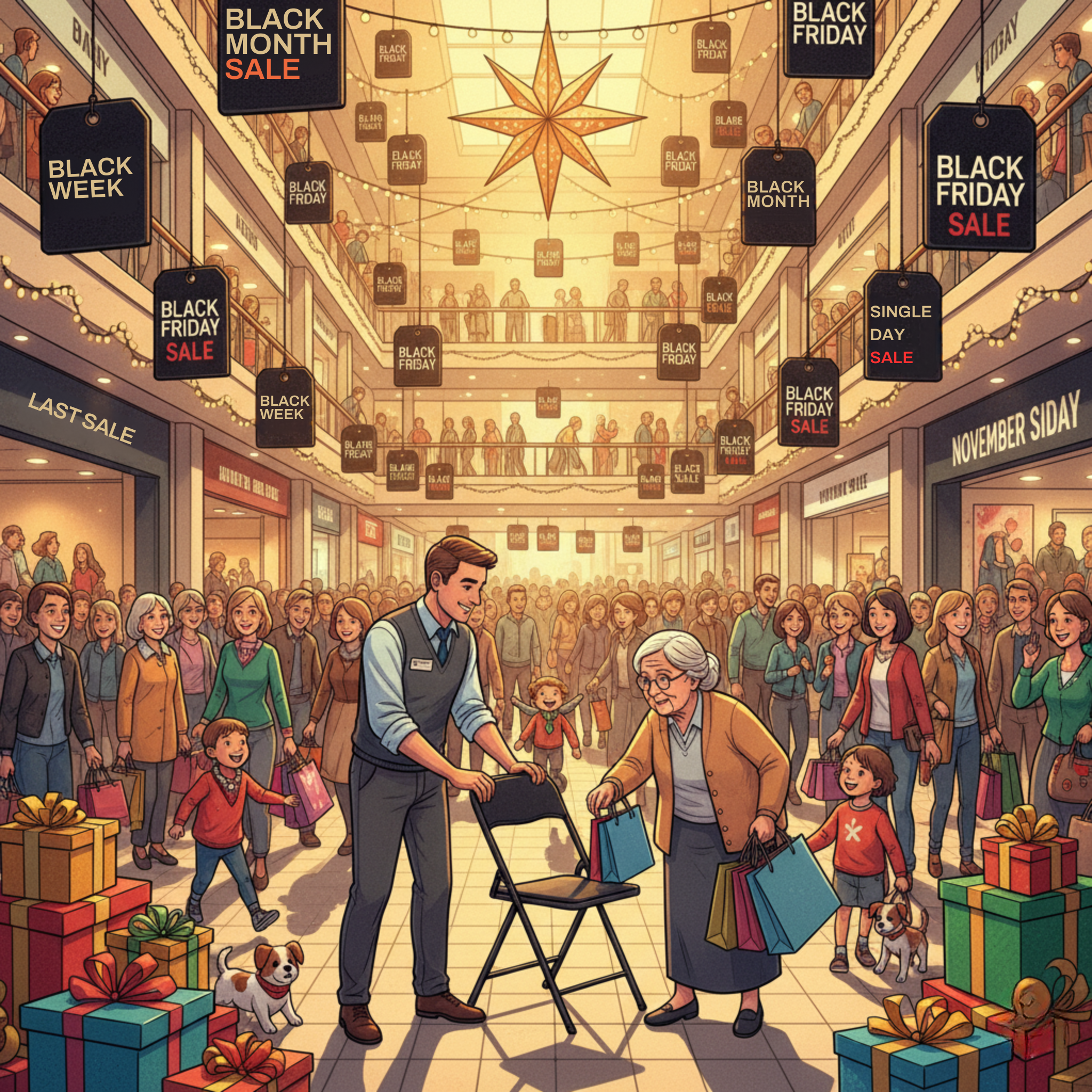
And just when I thought this was another scene of December exhaustion — a security guard walked out from the back with a simple, almost forgotten black chair. He removed the “staff only” label, placed the chair in front of her, and quietly said:
“Here, please sit. Take your time.”
No one filmed it.
There was no campaign, no slogan, nothing Instagram-worthy.
But it was a moment worth more than every black discount combined. The black chair.
Not because it was spectacular — but because it was human.
And humanity is a currency you won’t find in any catalogue.
That small gesture is a reminder that a shopping centre becomes a destination only when things happen inside it that cannot be wrapped, scanned, or printed on a receipt.
So how do we attract people in a time when everyone is shouting that we must buy everything right now?
Not with volume.
Not with complexity.
Not with “exclusive” discounts that are available to everyone.
People want simplicity.
They want to feel that someone is making their life easier, not harder.
That means:
- making things easy for them (gift cards as a stress-free solution)
- recognising them (loyalty as a relationship, not a point system)
- giving them a moment of calm (a space where you breathe instead of rush)
- understanding their habits, not guessing them (a data-driven approach)
Customers will forget the discount. But they won’t forget where they felt comfortable.
If we want new customers, we must give them something they can take home — something that doesn’t fit in a shopping bag. A moment of kindness, the feeling that someone took two seconds for them, or that one security guard with a simple black chair.
And so the most important question is not “what are we selling?” but “how do people leave us?”
Do they leave exhausted or relieved?
Do they walk away with the feeling that they completed a task, or that they received something unexpected — a brief moment of care, calmness, humanity?
In the Advent rhythm, we sometimes lose ourselves. Too many lights and too little light. Too many decorations and too little meaning.
That’s why I want to remind us of something essential: people need places that bring them back to themselves, not just places that encourage them to spend. Shopping destinations that offer warmth, sustainability and genuine care — not just decoration — become something else entirely. They stop being a location. They become a place.
And the difference is enormous.
That is what remains.
Everything else is — seasonal sale.
Mila Triller
Connect with me