Live, Virtual, and Hybrid Events: How to Choose the Right Format?
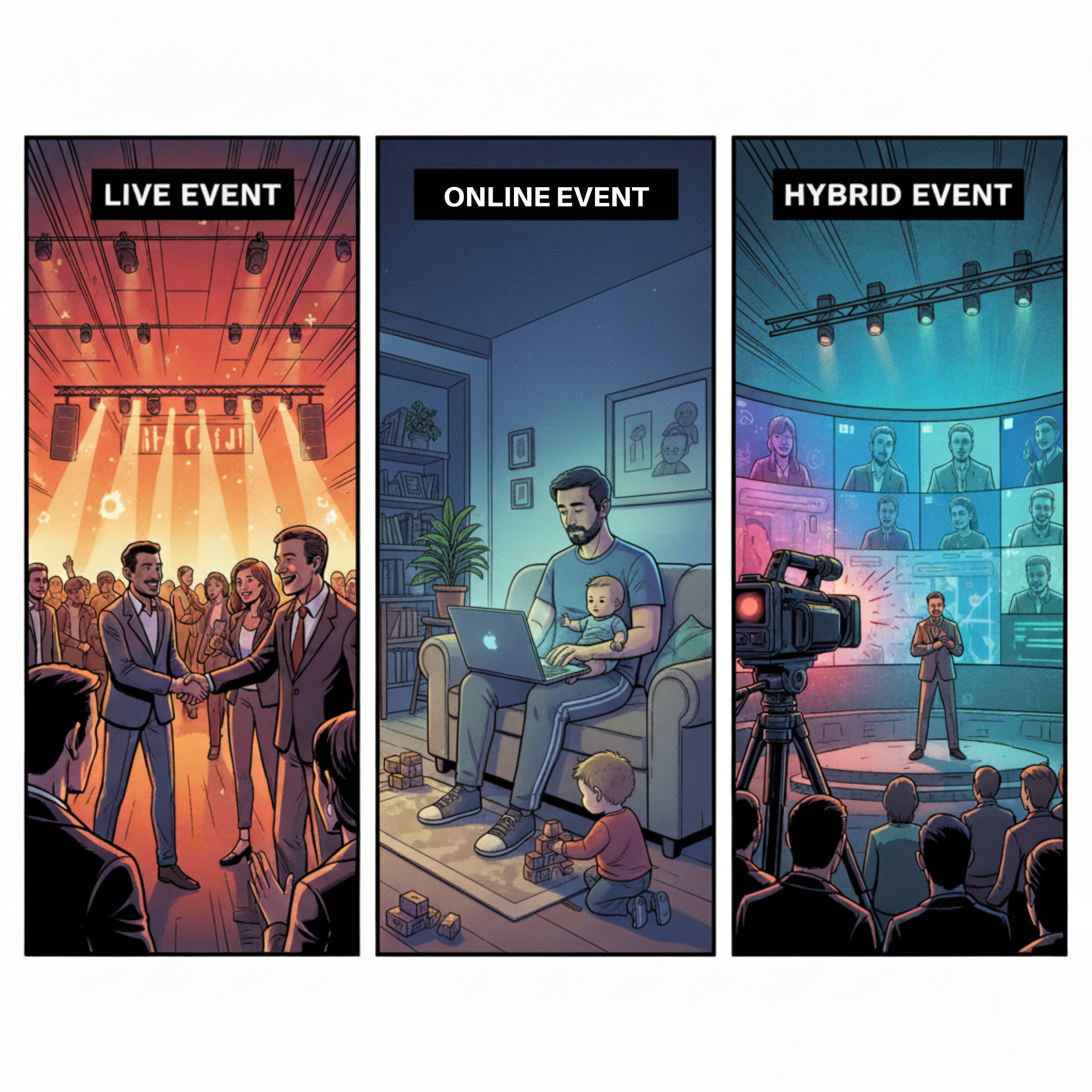
When we talk about events today, we quickly realise that the world has split into three distinct realms: live, virtual, and the one in between — hybrid. Each format has its own strengths and weaknesses.
1. Live Events: Energy, Human Connection, and Growing Selectivity
With in-person events, one thing is clear: most people crave real human contact. A handshake, a chat over coffee, casual conversation — the feeling of truly *being there* is what matters most.
Yet today’s reality is that there are simply too many live events. When there are so many, people are forced to choose. In the past, content alone was often enough to decide. Now other factors dominate: location, date, who else is attending, the target audience… and, of course, whether the company even allows employees to attend a particular event. In large organisations you increasingly hear: “Pick two events per year… and that’s it.”
This means organisers are no longer just fighting for attention — they’re fighting for a slot in increasingly packed calendars.
2. Virtual Events: Greater Reach, Lower Costs, but a Different Dynamic
Virtual events offer something a live event can never achieve: vastly greater reach.
They make it possible to include people who, for whatever reason, would never attend in person. Instead, they join online, browse or watch the content that interests them, and often come back later if something catches their eye. The content remains available, videos can be rewatched, and even those who miss the live broadcast still get all the key information.
The cost structure is completely different too. No catering, no travel, no hotels, no printed materials, no headaches with venue logistics. That said, virtual events should never be treated as the “cheap option.” If an event represents a brand, it must be executed to the highest standard — regardless of format.
One of the greatest advantages of the virtual world is analytics. At live events, feedback is usually limited to comments like: “It was great, the food was good, the band was awesome.” Online, content takes centre stage. You can see exactly which topic generated the most interest, how long people watched each session, which documents were downloaded, which sponsors got the most views… In short, guesswork is eliminated.
3. Hybrid Events: The Most Demanding — and Often the Most Effective
Then there’s the combination of both worlds: hybrid. Let’s be honest — this is also the most challenging type of event.
Why? Because you’re essentially creating two separate events: one in the physical room and one behind the screen. And these two are not the same. The director managing the stage and the director handling the online stream are not the same person — the dynamics are completely different.
If you want the online experience to hold attention, it has to be directed like television: camera movements, transitions, pacing, a host who knows how to engage and guide online viewers toward additional content… everything must be perfectly coordinated.
A hybrid event enjoys all the benefits of virtual (longer lifespan, wider reach, analytics, extra digital networking opportunities) while retaining the very best aspect of live events — genuine personal contact.
4. Analytics: Where the Biggest Differences Emerge
Regardless of format, analytics is now what separates a good event from a truly outstanding one.
At a live event you never really know who connected with whom, what actually interested people, or what they took away. In the digital environment, as mentioned, you see everything:
- What someone watched
- For how long
- Which documents they downloaded
- What interested them most
- Who they scheduled a meeting with
All of this gives organisers an entirely new level of audience insight — extremely valuable data that can be used to improve future events and drive sales.
5. Networking: The Biggest Weakness of Purely Live Events and the Greatest Strength of Digital Ones
In-person networking without advanced digital tools often works on the principle: “If you already know someone, great. If not, good luck.”
Groups who already know each other cluster together and chat, while introverts stand in the corner holding a coffee and looking for the exit. Digital tools solve this elegantly: they match people by interest, suggest relevant contacts, allow meeting slots to be booked, show participant profiles… so that when a guest arrives at the live event, their meeting schedule is already in their phone. No wandering around. No wasted time. Above all, they already know the person before they sit down together.
Conclusion
Every event type has its place. Live events bring energy and authentic connection. Virtual events deliver greater reach, better analytics, and accessibility. Hybrid events combine the best of both worlds — but only if they are executed professionally.
In today’s business environment, the organisers who come out on top are those who understand that success does not end when the event is over. Real success begins only afterwards — when you dive into the data you’ve collected and turn it into concrete results.
Jaka Gornik
Connect with me